The Royal Alexandra Hospital Foundation (RAHF) is one of Alberta’s leading health foundations, raising funds to support the Royal Alexandra Hospital and its specialized health centres, along with Lois Hole Hospital Women’s Society and Alberta Women’s Health Foundation. With multiple initiatives under its umbrella, important campaigns like Giving Tuesday, and large events like Harvest Celebration, the foundation needed a digital marketing partner who could bring structure, clarity, and measurable results.
When we began working with RAHF in 2021, the immediate need was clear: manage digital advertising, fix broken tracking, and put reliable systems in place.
Those early projects were hands-on and execution-heavy—creating campaigns, optimizing ad spend, and fixing their tracking. But as the partnership grew, so did the scope of what we were building together.
Over time, our role shifted from just doing the work to also sharing our knowledge. We hosted training sessions for Google Ads, Meta Ads, and LinkedIn Ads, and created guides to help their Digital Strategist become more familiar with each platform. By 2024, the relationship had evolved into a hybrid model: they ran campaigns during quieter periods, and we stepped in for heavier lifts during peak fundraising seasons when they were crunched for time.
Today, the partnership is lighter-touch but still collaborative. By spending less on having an agency do all of the execution, RAHF has redirected funds to hire an additional staff member to support their Digital Strategist. Instead of being spread too thin, they now have the time to focus on implementation and planning—work that they didn’t have time for before due to an overwhelming workload. With monthly check-ins and strategic support from our team, the foundation keeps campaigns on track while steadily building confidence running their digital marketing in-house.
Together, these successes show the impact of investing in both trackable results—such as event registrations and donations—and in building RAHF’s long-term capacity as an organization. By creating processes, improving tracking, and training staff, the foundation is better equipped to run effective digital campaigns on its own, adapt to change, and sustain growth well into the future.
Increasing Event Attendance
Between Us (previously known as What The Health) is a free interactive lecture series that the Lois Hole Hospital for Women’s Society puts on in partnership with Alberta Blue Cross. Each month, health experts discuss women’s health topics ranging from maternal mental health to perimenopause.
Before working with us, they didn’t get a lot of people registering for the event—the events simply weren’t reaching enough of the right people. To change that, we ran two types of Facebook campaigns: one optimized for conversions (registrations on their website) and another for event responses (directly through Facebook). By optimizing for the specific action we wanted people to take—not just link clicks—we gave the algorithm a clearer signal, and it delivered.
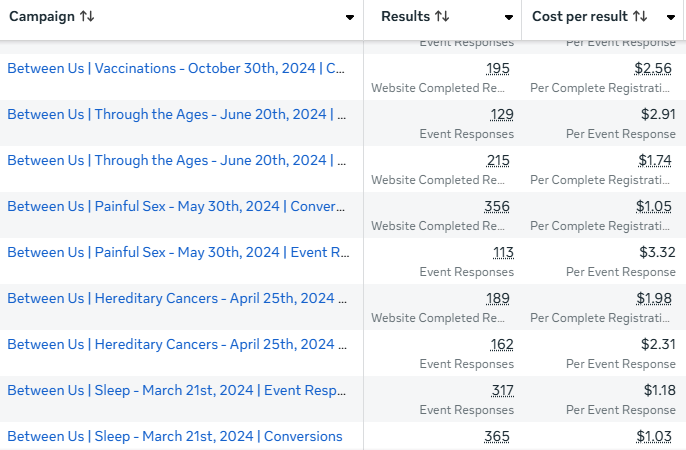
The results? Attendance skyrocketed! We loved getting emails like this:
“Mini update on March’s Between Us event: We raised $770 in donations and had 781 registrants with 382 attendees! This is the HIGHEST number of registrants we’ve ever had.“
and this:
“This event had the highest number of registrants we’ve ever seen! We’ve never had this many people register for an event before. In fact, it was so high that we had to expand our Zoom capacity.”
Because the series is free, with an option to donate, it removes a key barrier to participation while still supporting the cause. It’s a win-win: the community gains access to valuable women’s health education, and LHHWS connects with new potential donors who may support future initiatives.
Building a Smarter Foundation: Strategy, Tracking, and Budget Alignment
Over time, we built a shared planning rhythm—forecasting campaign budgets while staying flexible—and learned the ins and outs of RAHF. As we understood their business cadence, collaboration got easier and faster: fewer iterations, quicker approvals, and smoother launches.
But none of that matters without reliable data. When we started working with RAHF, the ownership of their GTM container and ad accounts were scattered across multiple people and agencies. That was one of the first things we helped them work on, to make sure that they had ownership and access to all of their accounts. There was also a disconnect in their Google Analytics implementation between their website and donation pages, which live on a subdomain. While tracking is never going to be perfect (even though we really wish it could be), we created an analytics plan, implemented more robust conversion tracking, and built dashboards so they could easily track KPIs that were important to them.
Thanks to clearer, more accurate campaign reporting, the marketing team at RAHF has the information they need to make strategic budget decisions.
Insights to Action: How We Evolved Our Strategy
Our partnership with RAHF wasn’t about following a playbook. It was about continuous testing, learning, and adapting. Here’s a few examples of how we refined our approach based on real performance data:
- Platform Testing & Optimization: Different platforms work better for different types of campaigns, and we’re always willing to test to find what delivers the best results. For events like Between Us, Harvest Celebration, and the Lois Hole Women’s Society’s Bid and Benefit we tried multiple Google Ads campaign approaches but weren’t able to match or get close to Meta’s results, so we stopped putting budget towards Google Ads and focused our efforts on Meta. The result? Reduced ad spend with similar (or better) results!
- Navigating Giving Tuesday: The week leading up to Giving Tuesday is an incredibly competitive time for charities, but timing matters more than duration. Over the years, we’ve learned that donor behavior is concentrated. The majority of donations happen on Giving Tuesday itself, not in the days leading up to it. You can’t artificially extend a moment-in-time event; people donate when they’re ready, and for Giving Tuesday, that’s the day itself. Focusing on awareness and showcasing the impact your organization has before Giving Tuesday is great so you’re top-of-mind, but putting budget behind the donation ask is best saved for Giving Tuesday itself. The result? 2024 saw their highest donations yet from Meta Ads!
- Optimizing for Quality Traffic: Optimizing for the end goal you want users to take after they click on your Facebook Ad makes sense. If you want more donations, you should optimize for donations. Right? However, if not enough people are taking action (donating) then you starve the algorithm of data and your campaigns perform poorly because they can’t make it out of the learning phase. We recommended optimizing for an earlier “conversion” called Quality Traffic (based on time spent on page and scroll depth) so we could give Facebook enough data to successfully optimize our ads to show to an engaged audience, instead of starving the algorithm.
This helped to feed our remarketing audiences, allowing RAHF to re-engage with people who’ve shown genuine interest in their cause.
Expanding Their Reach
Microsoft Ads
We helped RAHF activate Microsoft Ads for Social Impact, unlocking in‑kind ad credits (similar to Google Ad Grants) which allowed them to expand their reach at no cost to their paid media budget. We handled enrollment and policy compliance, built grant‑only campaigns with dedicated tracking, and set simple guardrails so the grant can run “always on” while cash budgets stay focused on the most conversion‑efficient campaigns.
(Sidenote: Unfortunately, Microsoft Ads is sunsetting this program. We’re sad to see it go!)
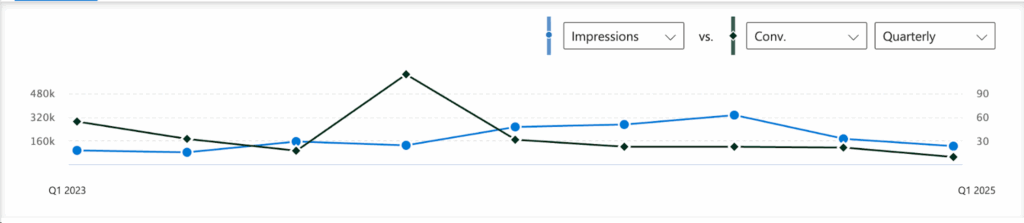
We were able to achieve steady impression growth. Conversions (especially donations), are very seasonal, with year end being the busiest time. The big spike in the image above was an anomaly quarter with higher than average conversion rates for non-donation conversion actions.
Google Ads & Ad Grants
What started as search-focused campaigns evolved into a multi-format Google Ads strategy, testing Performance Max, Demand Gen, and Video. This wasn’t about chasing every new feature; rather, it was about meeting RAHF’s audience where they are. Many initiatives lacked the search volume to support Search campaigns, so we leveraged alternative targeting methods and ad formats to find new ways to engage.
Like many non-profits, RAHF struggled to see meaningful results from their Google Ad Grants account. Their keywords were either too broad (and therefore irrelevant to their organization) or too specific to see any search volume. Add on minimal, untrustworthy conversion tracking and it was not surprising that the account was not delivering any real value. We rebuilt their grants account from the ground up: implementing proper conversion tracking, restructuring campaigns with targeted keywords, writing compelling ad copy, and ensuring ongoing policy compliance.
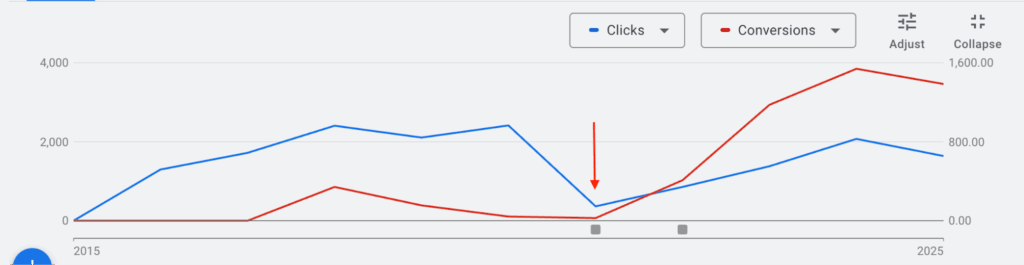
The arrow on this chart shows when we took over the account. By improving conversion tracking, managing compliance issues, and improving keyword relevancy, we were able to see a drastic increase in conversions, while keeping traffic to the website at similar levels. Their Ad Grants account became a valuable awareness tool that runs year-round without touching their paid media budget.
LinkedIn Ads
In 2022, we added LinkedIn Ads to RAHF’s strategy, focusing on two key campaigns: year-end giving and their annual report. Unlike Meta or Google, LinkedIn gave us direct access to healthcare professionals and decision-makers—audiences deeply invested in healthcare innovation. It was also another channel that we could leverage remarketing to nurture people to donate. By reserving LinkedIn for these strategic campaigns rather than using it year-round, we maximized budget efficiency while reaching quality audiences who care about RAHF’s mission and impact.
Supporting the Full Donor Journey
When RAHF first approached us, they wanted to increase online donations by 5% each year (25% in 5 years), and later expressed that they thought they could increase that by 10% each year (50% in 5 years)!
Despite having this goal, a lot of the campaigns that were planned weren’t focused on generating online donations. We primarily ran campaigns to raise awareness for their causes such as women’s health, vision health, and heart health, as well as campaigns to showcase and educate Albertans how their donations were being used (via their annual report). We also ran campaigns to support their different initiatives, such as promoting surveys for AWHF to support the creation of their thought leadership reports (Surveying the Silence and Shining the Light).
Can all of these things support online giving? Absolutely! But while online giving metrics only capture one part of donor behavior, our campaigns supported the entire donor journey. Someone who engaged with our awareness campaigns might later:
- Attend Harvest Celebration (event revenue)
- Purchase Full House Lottery tickets (lottery revenue)
- Make a legacy commitment (planned giving)
- Encourage their employer to become a corporate sponsor (corporate support)
- Donate after receiving a letter in the mail (direct mail)
These things aren’t online donations, but they are still important actions!
Where we found the most success with increasing online donations was through remarketing campaigns and brand campaigns, as these people are already familiar with the foundation. While we did run campaigns focused on generating donations, they often weren’t successful due to it being a big ask for a cold audience and the highly competitive nature of charitable giving in Alberta.
Asking someone who has never heard of RAHF to immediately donate $50, $100, or more is an enormous ask. Unlike e-commerce where someone might impulse-buy a $30 product, charitable donations require:
- Trust in the organization
- Understanding of the cause and impact
- Emotional connection to the mission
- Financial capacity and willingness to give
- Confidence that their donation will be used effectively
This is why direct donation campaigns to cold audiences typically see low conversion rates and high cost-per-acquisition, often making them financially unsustainable for charitable organizations with limited marketing budgets. Nurturing these audiences first through awareness campaigns, then converting them through remarketing, proved far more effective and sustainable.
We didn’t meet RAHF’s original online donation goals, but we did build something more sustainable—we built awareness and trust that supported RAHF’s entire fundraising ecosystem during one of the most challenging periods in charitable sector history. (Thanks, COVID!) Online giving gift volume is back to pre-pandemic levels and online gift income has seen a 44% increase year over year (it’s worth noting that the Canada Post strike likely played a role in this as more donors shifted to giving online).
According to their 2024 annual report, “the foundation has achieved an impressive feat of doubling the fundraising net revenues.” This is the growth that matters!
One of RAHF’s long-term goals was to manage their digital advertising in-house. To get there, they needed someone on their team trained on Facebook, Google, and LinkedIn Ads—but learning on your own is challenging. With countless resources available and platforms constantly evolving (new features, algorithm updates, deprecated tools), it’s hard to know where to start or how to adapt. (That’s why Full Stacks offers training!)
When we began training RAHF’s Digital Strategist in 2022, they didn’t have bandwidth to immediately take over all of their campaigns, but they wanted to start learning and develop an ads mindset. We began with Facebook Ads: multiple one-on-one training sessions via Zoom covering campaign types, settings, audiences, ad creation, and key metrics. We also provided a written guide they could reference later alongside video recordings of the training sessions.
But we didn’t just train and disappear. Because platforms change constantly, we built in ongoing support: monthly check-ins to answer questions, share relevant updates, and explain how those changes would impact RAHF’s campaigns or create new opportunities.
Training later expanded to include Google Ads and LinkedIn Ads. The progression was gradual but intentional so they weren’t overwhelmed. They started by observing our campaign setups, then moved to co-creating campaigns with our guidance, and eventually to planning and launching campaigns independently during quieter fundraising periods. When peak seasons hit (typically Q3/Q4) we’d step back in to handle the heavier execution while they focused on their main role of managing social media for the foundation. We also provided Google Analytics 4 training to help them understand their data across all online channels, not just ads.
In 2025, RAHF hired a second team member to support their Digital Strategist, finally giving them capacity to work on ads full-time. Now, instead of being stretched too thin, they have time for the strategic planning and implementation work that was impossible before. Our role has evolved into monthly reviews: they bring questions, we troubleshoot together, and we keep building confidence.
The result? RAHF now has sustainable in-house capability. They’re not dependent on an agency for every campaign launch. When we review their campaigns, there are less mistakes (such as settings missed or no UTM tracking added). Questions are shifting from “how do I set this up?” to “which approach will work better for this campaign?”. There is still room to grow, but we’re so proud of the growth we’ve seen!
We love that the foundation invested in developing their team’s skills and then brought on additional staff to support them. Redirecting agency budgets toward building internal capacity is exactly the kind of long-term investment that pays off year after year.
“It’s been a pleasure working with Brittany, Sammy, and Dana over the past three years. I’ve learned so much from their training on Google, Facebook, Microsoft, and LinkedIn ads, as well as their guidance and support while I transitioned into managing the paid side and expanding my knowledge in GTM and Google Analytics. I’m truly grateful for everything they’ve done to set RAHF up for success and ensure we can confidently handle things on our own. It’s been wonderful learning from them, and I deeply appreciate all the support they’ve provided along the way.” — Rebecca Han, Lead, Digital Strategist
Like many non-profit organizations, RAHF operates in a world of big goals, limited resources, and constant change. That reality shaped some of the challenges we faced together:
- Technical constraints: Donation platforms used in the nonprofit sector often use iframes and other tracking-unfriendly options, making it difficult to track more than the basics.
- Timeline pressure: With a small team juggling multiple brands and events, things don’t always move at the speed of digital. Campaigns often faced delays due to waiting for new donation pages to be created, creative content from another agency, or internal approvals.
- Ad platform sensitivities: Because healthcare fundraising touches on social issues, ads were occasionally flagged or disapproved. While not constant, it created extra steps to get campaigns live and meant that if a campaign was flagged for social issues we couldn’t use certain features, such as Advantage+ audiences on Facebook.
- Ownership gaps: Early on, access and ownership of critical assets—like their Meta pixel and domain verification—wasn’t owned by RAHF but by another agency they previously worked with. It took time (and some sleuthing) to gather all their assets. We always recommend that clients have ownership of their own accounts (analytics, ads) and other assets!
- Constant platform changes: Shifts in how platforms like Facebook (pixel changes, core event setup, Advantage+) and Google Ads (audience eligibility changes, PMAX, healthcare policy updates) work meant ongoing adaptation was required to keep campaigns compliant and effective.
- Shifting teams and priorities: Staff turnover is a fact of life in non-profits, and each change can mean campaigns pause, evergreen efforts lose momentum, or new initiatives get delayed.
- Risk appetite: Trying new approaches (like Facebook for Nonprofits) can feel daunting when every dollar counts, which makes nonprofits naturally more cautious about experimentation.
- Donor fatigue & external context: Economic uncertainty, healthcare strain in Alberta, and donor fatigue during/after the pandemic made it harder to hit aggressive fundraising targets.
- Competing priorities: With so many campaigns across multiple brands (RAHF, AWHF, and LHHWS) there was sometimes a challenge in deciding which initiative should get priority digital spend and focus.
- Resource constraints: Like many nonprofits, RAHF operates with lean teams and tight budgets. Video content was particularly challenging as producing quality videos requires time, equipment, and expertise that weren’t always available. We worked with what existed or got creative with simpler formats, even when we knew video could drive stronger results.
These aren’t unusual hurdles—they’re the everyday realities of digital marketing in the non-profit world. What matters is building the flexibility to work through them, and that’s what kept this partnership moving forward.
Looking back on four years of collaboration, a few things stand out as the foundations of what made this partnership successful.
We stayed flexible as their needs evolved. What started as hands-on campaign management naturally shifted into training, then coaching, and now strategic support. We adapted as RAHF’s capacity grew and their priorities changed. That meant being willing to step back and celebrate when they didn’t need us as much anymore.
Honest communication kept us aligned. When campaigns didn’t perform, we said so. When their goals felt unrealistic given external challenges (donor fatigue, competitive landscape), we had those conversations. And when they had capacity constraints that would delay work, they told us. That transparency made it possible to navigate challenges without blame or frustration.
The real success isn’t just the campaigns we’ve launched—it’s how the foundation has grown its own capacity along the way. That journey from “do it for us” to “do it with us” to “doing it ourselves, with you as a sounding board” has become the hallmark of our work together.
Does Your Non-Profit Need Training?
Ready to build your team’s digital marketing skills? Contact us to learn how we can support your nonprofit through customized training and coaching.